


When looking for a drug treatment center in Sacramento, families should find a level of care that fits the person’s addiction severity, medical needs, mental health, and home life. The first step is a clinical assessment using the American Society of Addiction Medicine (ASAM) Criteria.
Choosing care that fits the person’s needs helps keep them safe and makes good use of time and money. This guide covers how clinicians measure severity, which settings work for different situations, and what to look for before choosing a treatment program in Sacramento County.
Why Matching Severity to Care Matters
If care is too limited, withdrawal or relapse risks may not be managed. Too much care can take extra time and money and interrupt work or family life. Clinicians try to find the least restrictive setting that keeps someone safe and supports their recovery.
Severity is about more than just how much or how often someone uses. It also looks at withdrawal risk, physical and mental health, motivation, relapse history, and how safe the home is. Two people who use drugs in similar ways might still need different care.
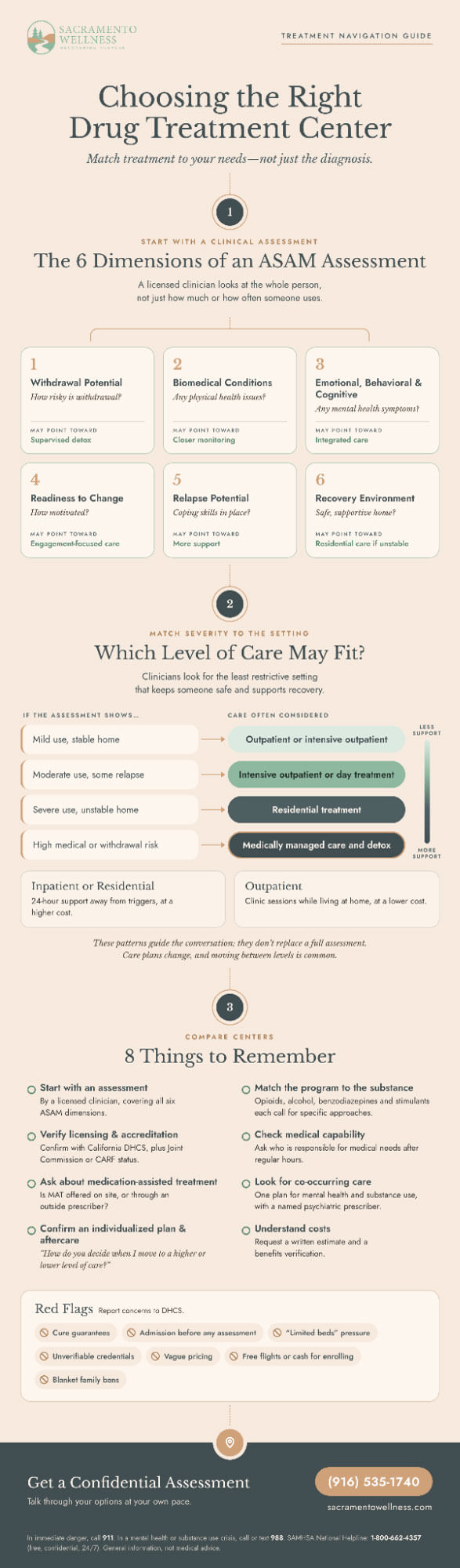
How Clinicians Measure Severity: Six ASAM Dimensions
Clinicians judge severity across six ASAM dimensions:
| Dimension | Question | Points Toward |
| 1. Withdrawal Potential | How risky is withdrawal? | Supervised detox |
| 2. Biomedical Conditions | Any physical health issues? | Closer monitoring |
| 3. Emotional, Behavioral, Cognitive | Any mental health symptoms? | Integrated care |
| 4. Readiness to Change | How motivated? | Engagement-focused care |
| 5. Relapse Potential | Coping skills in place? | More support |
| 6. Recovery Environment | Safe, supportive home? | Residential care if unstable |
Which Level of Care Fits?
Assessments often point toward these general care levels:
| Situation | Care Often Considered |
| Mild use, stable home | Outpatient or intensive outpatient |
| Moderate use, some relapse | Intensive outpatient or day treatment |
| Severe use, unstable home | Residential treatment |
| High medical or withdrawal risk | Medically managed care and detox |
The two main settings differ:
- Inpatient or Residential: 24-hour support away from triggers, at a higher cost.
- Outpatient: Clinic sessions while living at home, at lower cost.
These patterns help guide the conversation but do not replace a full diagnosis. Review the different care levels for more details.
8 Things to Remember When Choosing a Center
This checklist is based on clinical advice.
1. Start With an Assessment
Complete an assessment before choosing a program. Confirm:
- Who Assesses: A licensed clinician.
- What It Covers: All six ASAM dimensions.
A lot of programs provide free assessments.
2. Match the Program to the Substance
Each substance calls for specific approaches:
- Opioids: Buprenorphine and methadone substantially lower overdose death risk.
- Alcohol and Benzodiazepines: Withdrawal can cause seizures and needs medical supervision.
- Stimulants: Behavioral therapies, especially contingency management, are a leading treatment.
If someone uses more than one substance, they need a plan that addresses each one.
3. Verify Licensing and Accreditation
Ask for proof of both credentials:
- License or Certification: Confirm it with California’s Department of Health Care Services (DHCS).
- Accreditation: The Joint Commission or Commission on Accreditation of Rehabilitation Facilities (CARF) status.
You can find more details on how to check this in our inpatient alcohol rehab guide.
4. Check Staff and Medical Capability
Look for medical and clinical depth:
- Licensed Staff: Physicians, nurses, and licensed therapists.
- Medical Coverage: On-site care or a documented medical partner.
At Sacramento Wellness, we recommend asking who is responsible for medical needs after regular hours.
5. Ask About Medication-Assisted Treatment
Medication-assisted treatment (MAT) pairs medication with counseling for opioid and alcohol use disorders. Ask whether programs:
- Offer MAT: Prescribe medication on site.
- Refer Out: Connect you with an outside prescriber.
Saying no to MAT for personal reasons can limit access to proven treatment options.
6. Look for Co-Occurring Care
Best practice treats mental health and substance use together. Check for:
- Integrated Treatment: One plan for both conditions.
- Psychiatric Care: A named psychiatric prescriber.
Find out how often patients meet with them.
7. Confirm an Individualized Plan and Aftercare
Quality plans change as you progress. Confirm:
- Plan Updates: Regular reviews that include your feedback.
- Aftercare: Schedule step-down care before discharge.
Ask, “How do you decide when I move to a higher or lower level of care?”
8. Understand Costs and Transparency
Clear pricing prevents surprise bills. Request:
- Written Estimate: Expected out-of-pocket costs.
- Benefits Verification: What insurance covers.
Reliable programs do not promise guaranteed results.
Red Flags to Watch For
Watch for these warning signs:
- Cure Guarantees: Promises signal marketing over care.
- Instant Admission: Entry before any assessment.
- Pressure Tactics: “Limited beds” urgency.
- Unverifiable Credentials: An unconfirmed license.
- Hidden Costs: Vague pricing answers.
- Recruitment Perks: Free flights or cash for enrolling may signal patient brokering, banned in California.
- Blanket Family Bans: Rules ending all family contact.
Report concerns to DHCS.
Paying for Treatment and Local Factors
Before selecting a drug treatment center in Sacramento, residents can compare these payment routes:
- Private Insurance: Verify benefits first.
- Medi-Cal: Covers eligible members through the Drug Medi-Cal Organized Delivery System (DMC-ODS).
- County Access Line: Call (916) 874-9754 for an assessment and referral.
- National Directories: FindTreatment.gov and the Substance Abuse and Mental Health Services Administration (SAMHSA) helpline, 1-800-662-4357.
Local factors also matter:
- Family and Transport: Nearby programs ease family sessions and travel.
- Residency and Aftercare: Public funding generally follows your home county, and local step-down care eases transitions.
At Sacramento Wellness, we suggest getting estimates from at least two programs to compare your options.
Get a Confidential Assessment
Finding the right care begins with an honest look at your needs, health, and home life. A private assessment can help you figure out which level of care is best for you. You can reach out to our admissions team to discuss your options at your own pace.
If you or a loved one faces immediate danger, call 911. For a mental health or substance use crisis, call or text 988. The SAMHSA National Helpline at 1-800-662-4357 offers free, confidential treatment referrals and information 24 hours a day.
FAQs
How do I know how severe an addiction is?
A licensed clinician assesses six ASAM dimensions. Screening quizzes only start the conversation.
Should I choose inpatient or outpatient care?
It depends on severity, medical risk, and stability at home. Clinicians favor the least restrictive safe option.
What is the ASAM Criteria?
It’s a six-dimension framework that providers and many insurers use to match patients with the right level of care.
Does Medi-Cal cover drug treatment in Sacramento?
Medi-Cal covers eligible members through DMC-ODS—call (916) 874-9754 for a county assessment.
Can I switch programs if the first stops helping?
Care plans change and moving between levels is common. Discuss options with your team.
What if my family member refuses treatment?
Readiness can grow. Families can stay connected, set boundaries, and seek guidance from a counselor or interventionist.